
Late Payment Penalty on Maintenance Fees: How Article 20 of the Turkish Condominium Law Works
The late payment penalty on maintenance fees under Article 20 of the Turkish Condominium Law: the 5% monthly rate, start date, part payments and examples.
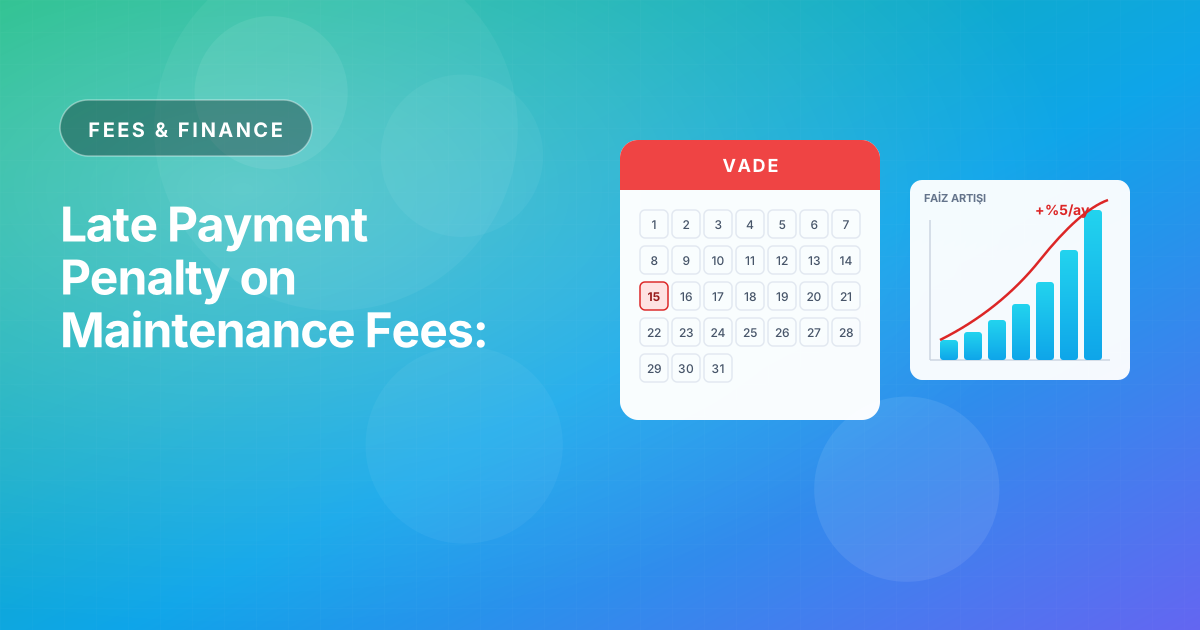
Short answer: under the Turkish Condominium Law (Kat Mülkiyeti Kanunu, KMK), a unit owner who does not pay their share of expenses and advances owes a late payment penalty "at the rate of five per cent a month" for the days the payment is late. On a daily basis that is 5% ÷ 30 = 0.1667% of the late amount per day. People often call it "late interest"; the legal term is late payment penalty (gecikme tazminatı).
Last checked: 27 September 2026. This article gives general information. Talk to a lawyer before enforcement or court action.
What the law says
Condominium Law No. 634, Article 20, second paragraph (our translation):
"Proceedings may be brought and enforcement may be started, in accordance with the management plan, this Law and the general provisions, by any of the other unit owners or by the manager against a unit owner who does not pay their share of expenses or advances. A unit owner who does not pay the whole of their share of expenses and advances is liable to pay a late payment penalty at the rate of five per cent a month for the days the payment is late."
The rate was reduced from ten to five per cent a month by Law No. 5711 in 2007. Three points follow:
- Who pursues it? Any of the other unit owners, or the manager. The manager's duties include taking legal and enforcement action against owners who do not pay (KMK Art. 35/i).
- On what? On the unpaid share of expenses and advances, for the number of days it is late.
- Is the tenant liable? A person who uses the unit permanently under a lease or a right of residence is jointly and severally liable with the owner for expenses, advances and the late payment penalty. A tenant's liability is limited to the rent they owe, and what they pay is deducted from the rent (KMK Art. 22).
A maximum, or a fixed rate?
The text says "at the rate of five per cent a month"; it does not use words such as "up to". A higher rate has no basis in the law. Whether the owners' assembly or the management plan can set a lower rate, or decide not to charge the penalty at all, is not addressed separately in the law, and views differ.
Our suggestion: write down the rate and the calculation method in an owners' assembly resolution or in the management plan. If you want to depart from the law, get legal advice first.
When does it start?
The penalty runs "for the days the payment is late", so the payment date (the due date) must be known first. The due date is not set by the law; it is set by the operating budget (işletme projesi), an assembly resolution or the management plan.
Under the Code of Obligations, if the date of performance was agreed, the debtor is in default when that day passes, without a reminder; if no date was set, the creditor must send a reminder (TBK Art. 117). In practice:
- The operating budget or resolution showing the due date and monthly shares should be properly notified to the unit owners (KMK Art. 37).
- Law No. 7579, in force since 22/05/2026, requires the operating budget to be approved by the owners' assembly; if there is no approved budget, the manager prepares a provisional one. Know which document your fees and due dates are based on.
- If you allow a grace period (for example 5 days after the due date), set it by resolution too.
Example: if the due date is 10 May 2026, the first late day is 11 May. By 10 June, 31 days have passed; on a daily basis that is 31/30 of a month, not exactly "one month".
How to calculate it
The law gives a monthly rate but applies it to days. The common method divides the monthly rate by 30 and multiplies by the number of days:
Late payment penalty = Late amount × (Monthly rate ÷ 30) × Days
Counting starts the day after the due date, and the calculation day is included. The result is rounded to the kuruş.
Example: a ₺1,500.00 fee, 18 days late 1,500.00 × (0.05 ÷ 30) × 18 = ₺45.00
Several months unpaid
Each month's fee is calculated from its own due date. Calculation date: 1 May 2026.
| Debt | Due date | Amount | Days | Late payment penalty |
|---|---|---|---|---|
| February fee | 10/02/2026 | ₺1,500.00 | 80 | 1,500 × 0.05 ÷ 30 × 80 = ₺200.00 |
| March fee | 10/03/2026 | ₺1,500.00 | 52 | 1,500 × 0.05 ÷ 30 × 52 = ₺130.00 |
| April fee | 10/04/2026 | ₺1,500.00 | 21 | 1,500 × 0.05 ÷ 30 × 21 = ₺52.50 |
| Total | ₺4,500.00 | ₺382.50 |
Part payment
After a part payment, the penalty runs on the remaining amount from the payment date.
Example: a ₺1,500.00 fee due on 10/04/2026; ₺1,000.00 is paid on 25/04/2026; calculation date 10/05/2026.
| Period | Base | Days | Amount |
|---|---|---|---|
| 10/04 → 25/04 | ₺1,500.00 | 15 | ₺37.50 |
| 25/04 → 10/05 | ₺500.00 | 15 | ₺12.50 |
| Total | ₺50.00 |
If the payment day itself is charged on the old balance, the days become 16 and 14 and the total is 40.00 + 11.67 = ₺51.67. The law does not address this boundary day. Write down which method you use and use it consistently.
Which debt does a payment settle?
When there are several debts, the Turkish Code of Obligations decides which one a payment settles:
- The debtor can say which debt they are paying on the day of payment; if they do not, the payment is treated as made for the debt shown on the receipt, unless they object at once (TBK Art. 101).
- Without a valid statement or a clear receipt, the payment goes to the debt that is due; if several are due, to the one enforcement was started on first; if none, to the one that fell due first (TBK Art. 102).
- A debtor who is not late with interest or costs has the right to set a part payment against the principal (TBK Art. 100).
The Condominium Law does not set a separate order between the fee and the late payment penalty. Whether the penalty counts as "interest" under TBK Art. 100 is open to interpretation; get legal advice if it is disputed.
Is a penalty charged on the penalty?
The law defines the penalty on the late share of expenses and advances; it has no provision for charging a further penalty on the penalty itself. Calculate it on late fees and advances only.
Common mistakes
- Charging more than 5% a month. There is no basis for it in the law.
- Charging a penalty on a debt with no set due date. If no payment date was set by resolution or budget, a reminder may be needed for default.
- Counting every started month as a full month. The law says "for the days the payment is late"; a monthly block method overcharges short delays.
- Carrying on with the original amount after a part payment. Use the remaining amount after the payment.
- The manager waiving the penalty alone. The claim belongs to the unit owners. Unless the management plan gives the manager that power, leave the waiver to the owners' assembly and record it in the resolution book.
Late payment penalties in Yonevo
- The daily method is the default: monthly rate ÷ 30 × days; each debt runs from its own due date on the amount still unpaid.
- The rate, due day, grace period and whether the payment day counts are set in the saved rule. The screen warns if the rate goes above 5%. A monthly "block" method can also be chosen; the screen notes that it may be disputed.
- No penalty is charged on a penalty. Records without a set due date, such as opening balances, are not charged either.
- In the penalty calculation, payments settle the oldest charge first by charge date; on the same day, the fee is settled before the penalty.
- Posting: penalties can be posted by hand, once a month or every day automatically. The part not yet posted can be shown on the statement as "not a record", or added to the person's penalty line every day.
- In enforcement files, principal and penalty appear as separate items.
Frequently asked questions
What if the debtor asks us to "cancel the penalty"? Only the creditor can waive a claim, and here the creditors are the unit owners. Unless the management plan gives the manager that power, put it on the owners' assembly agenda and record the decision in the resolution book.
What happens to the debt if the owner dies? Death does not end the debt; heirs inherit the estate as a whole (Turkish Civil Code, Art. 599). Heirs can reject the inheritance within three months; if the deceased was clearly insolvent at the time of death, the inheritance is treated as rejected (Art. 605–606). Document who the heirs are before you take action.
Can the penalty be claimed from the tenant? Yes. The joint liability in KMK Art. 22 covers the late payment penalty too, but the tenant's liability is limited to the rent they owe.
Do we need mediation before going to court? For disputes arising from the Condominium Law, applying to a mediator before filing a lawsuit is a precondition of the lawsuit (Law No. 6325, Art. 18/B). Enforcement proceedings are not a lawsuit; the requirement comes up if the debtor objects and you file a lawsuit to set the objection aside.
Sources (in Turkish)
- Condominium Law No. 634, Art. 20, 22, 35, 37
- Turkish Code of Obligations No. 6098, Art. 100–102, 117
- Turkish Civil Code No. 4721, Art. 599, 605, 606
- Law No. 6325 on Mediation in Civil Disputes, Art. 18/B
Make management easier
Maintenance fees, collections, accounting and resident communication in one place.
Try Yonevo for free →